L and I had so much to say we had to split this into two sessions! We talked about inheritances of denouncement, music, writing, unionising, protest, encampments, the institution, the archive, love, value, Don Mee Choi, and tear gas. Thank you so much, L, for always being so, so insightful, whether over pork chops in your tiny flat at the residency, while driving me to the airport 3 hours away (with Z in the backseat!), or now on the phone from so many timezones away :)
---
The idea for this project is that I’m interviewing my friends and people I feel close to, who inspire me. There’s obviously a difference between this ‘on the record’ discussion, which will be published online for anyone to read, and the normal ‘off the record’ conversations we’d have as friends. I’m interested in the ways I might get to know you more through this slightly more ‘formal’ format and the choices you make in representing yourself. I’m also interested in oral history as a form, and in ways to preserve and archive intimacies and relationships in time and space.
Please come up with how you want to be called: name, initial, or pseudonym. I’ll be “Jiaqi Kang.”
The questions below are the 6 main questions I’ll ask you, but your answers will probably prompt some follow-up questions. Your answers can be as long or short as you want. The interview will be conducted orally, then transcribed using NoScribe and edited for length and clarity. You’ll get to take a final look at it before it goes up, and of course I can take it down anytime you like in the future (although it’s on my blog+newsletter which means that it will also exist in people’s email inboxes).
1. Please introduce yourself and your background, in any way you’d like.
2. How did you become politically engaged?
3. How did you and I meet?
4. What does the word ‘care’ mean for you?
5. What are some things you’re currently looking to learn, or learn about?
6. Is there anything else you’d like to say, or to ask me?
Thank you <3
This interview was conducted virtually in February and March 2026. It has been edited for length and clarity.
---
Jiaqi Kang: Hello, thank you so much for doing this. Please introduce yourself and your background in any way you'd like.
L: I'm super happy to be here. I'm L. I'm not going just straight to [the] very basic “where I'm from” and all these identity things [and my] professions. I think it's really interesting when those things are challenged. What I'll say is that, in many ways, I've been trying to think of myself as a language worker.
My background is someone who dabs a lot from the get go, and that leads me to generative spaces sometimes. This has led me to go from being poet to writer to language worker; from explicitly identifying as ‘political’ to an organizer to being less explicit about it in an identifying way. I'm a person who speaks many languages. I'm a person who grew up in the United States.
I feel suddenly stumped by the question! This new register has caught me somehow.
I think the important stuff for me recently, or in my life, has been [the fact that] my background is as someone who grew up in the United States, and grew up not identifying with the U.S. as a place that was my own. I grew up speaking multiple languages and very explicitly being shown how that made it so I didn't fit, both from the inside and the outside. And so I think that's made me a person who feels on the edge of things, while also being at the center of so many things, like empire.
JK: I really get the awkwardness and self-consciousness about this register. Like we said briefly before we started recording, you talked about how it's interesting, like, there's a kind of jarringness or disorientation to this register, which is an interesting frame.
L: Yeah, it is. I mostly just feel a lot of excitement because I just think that this is really interesting. It was such a good idea when you first told me about it, just this idea of acknowledging the different register, being curious about what it would mean to bring a relationship into a different sort of register. For me, that's how I thought about this interview.
I think what's been true is I identify as a person who thinks through language. For me, the metaphor of the register works a lot for me.
JK: How did you become politically engaged?
L: I was trying to track this. There's so many different avenues or stories. I think what the compelling answer may be, is this idea that I, for a while, I really thought [being politically engaged] was a birthright, almost. I grew up speaking Spanish in the United States; I grew up being related to people from Argentina, people who had been under a military dictatorship that was, in many ways, enabled [by the US], but also was a manufactured sort of response of the American government and the American culture. I definitely feel like [there was] this idea—that I thought was very true, and sometimes still feels very true, very inherent to my positionality and how I was brought up—[that] there's no other option but to be political.
As I've gotten older, I think that the other reflection on that… First, there's been allowing myself to be more of a protagonist, in that we all need our own sort of stories for ourselves. That was an important thing, was to allow myself to be more of a protagonist [in my life] and to not [perhaps passively] inherit everything. [Secondly], the people who gave me more language or more of a base to be political [later on in life as well]. [Another aspect to reflect on is] my psyche—which is maybe also related to how I was raised—as a person, I have a problem with authority, to my detriment sometimes. All these things in which I feel like I act [have] led me to become more politically engaged.
So I guess one of the stories that's important is this one of being from Argentina and growing up predominantly in the U.S.; growing up around a parent who had a lot of political discourse around, who was very explicitly like, “Fuck this politician” or, “Something should be done.” I grew up in a house that had a lot of strong sense of… I guess, in some sense, the word is “protest”, but there's another word that starts with a D that I can't remember—oh, “denouncement.” I grew up around a lot of denouncement. [My dad] denounced certain things as being evil or part of a fucked up system. Religion was something that was very heavily denounced, and religious authority—and in that, a distrust of spirituality as well, which was something that then I found was troublesome later on (well, parts of it.)
But yeah, denouncement was a very important part of my political engagement, and, in many ways, it's led me down an artistic path, because part of [how] I see myself as a person who makes things in this world is [that] I'm interested in archives of denouncement. That's one of the things that you can do with art and its relationship to political engagement: art can be a sign of life, and I can hold an archive of the resistance, or of a culture that is not normative culture, is not the culture which reigns. For me, a lot of what motivated me to be political was a lot of protest music from South America. Right now, I'm thinking so heavily of Mercedes Sosa, who taught me that idea of denouncement explicitly in that word. In this trip she took to Cuba, she said something along the lines of [her work] not necessarily being political music or protest music, but music that ‘holds a denouncement’. Something is being denounced inside of it. The artistic thing can hold that [denouncement] clearly, can maybe show you that clearly—which can be helpful to a political life. Also, then, the idea of holding a record of a certain struggle; [art] being an important part of doing that.
This capacity to kind of be an outsider inside of empire in the U.S.—to denounce it constantly, to not identify with what I was seeing around me—was really important. But as I grew up and I became more politically engaged, I think what happened was I realized that this capacity to denounce was a… false promise. Maybe [that’s] one way to say it. It's this idea, the Fred Moten and Stefano Harney idea behind The Undercommons, where the reality of that book is that they are trying to help each other [to] not just critique, but to find something other than critique. That's something that they have said before in interviews. I do think that critique can be a thing that can lead to something else, or it can be a false thing, something that actually makes you feel like you did more than you actually did. [As] I grew up, I started trying to do more things based off of these kind of idealistic political beliefs that I had—and also [beliefs] that are in many ways almost metaphysical and spiritual, [such as] the desire to be whole, to not have to lie (I was obsessed with not lying in school: I knew I couldn't get a lot of work done, and lots of people were really trying to get good grades and doing everything possible, and it felt important to resist that; that was a very juvenile, idealistic resistance of mine). From the denouncement, I tried many things. I was involved in Bernie Sanders electoral politics, and I tried to make things happen at my college, trying to start a union in some ways, and participating in organizations, trying to connect with city organizing with various degrees of success, mostly not feeling that successful or that connected.
I studied [abroad] in Spain and in Chile. In Chile, I was in Santiago. Thanks to other people who were from my university, who had already been there first and were there for another semester, I got to know really amazing organizers, and be shown what sort of [things]... These songs that I had grown up with, that had these denouncements, [I got to see such denouncement] in action, with this kind of beautiful steadfastness. It [became] clear [to me when I was in Santiago] that there was this hole, [something] that I didn't have. All these circles where it felt like politics were happening were based around identity in this way that felt exclusionary sometimes. Exclusionary not to me, because people were identifying with each other, and they were just identifying with each other, but it wasn't leading to something politically interesting. Then I was shown, in Santiago, this whole other way of people ‘identifying as political’ in a way that led to things happening. In Santiago, thanks to some friends and to lots of people I met there, that I started becoming involved—I started understanding what it meant to be involved in something at the level of the streets, you know, really giving a shit about the people who live around you, in and outside of houses, and figuring out what it meant for everybody to feel supported. On Pride Day, walking past the state-sanctioned march and going [instead] to the march that was not allowed, and just seeing how it's so beautiful, how you can decide to be with people.
I was at this protest once: my friends were in the Pan Y Rosas, which is essentially feminist Marxists, and the Pan Y Rosas people oftentimes went with this one communist party. We were in this march and in front of us were the Palestinians, who always went to all the marches—there's a huge Palestinian diaspora in Santiago—and then behind us was the black bloc—they were always gonna eventually do something. At the back was the University of Chile Antifa Association, which is University of Chile… Actually, I said that wrong…
JK: University of Chile antifa football fans, right?
L: Yeah, exactly, yes, yes, I've talked to you about this before. It was fans of a [football] team who were also anti-fascists, who were also organizing for these marches. Marches would go, and the cops would come, and I didn't even know at the time, but I had filed the wrong paperwork, so I was super illegally in Chile. I got fined for it—I paid all my fines—but at the time, the risk had not been properly weighed, like, it probably wasn't worth [potentially being arrested], but it was so beautiful. I think about that time so importantly, and I think that was a catalyst. Everything I had felt before and had tried to do before had a new vigor. The parts of the United States I grew up around were middle class and quite white places that were surrounded by much poorer and much less white places—this was another way in which to now account for the political culture of my upbringing. They had accounted for abstract political views, but not for the context and its contradictions that I was seeing growing up. That context of growing up was really confusing in many ways…It wasn't [literally] confusing, it was very clear that these failures [were structural], but confusing because I felt politically engaged, but ultimately not part of a political community. [I came to see that] a lot of the organizing that was happening around me was very proper. I mean, it was bad organizing, essentially. At least ‘bad’ for what you and I would think of as bad, because it was interested in these things that, in the end, were little roses. Like, it's a “pride flag t-shirt at a Target” type of organizing. That's not even organizing, but, you know, it's that sort of political aspiration. [Instead], understanding that there were standards that were real, and the standards were life and fighting for it, instead of [life conceived] romantically. [In Santiago,] things became a lot more clear, and things were allowed to be a lot more complex. Permission was a big part of it: I felt in the U.S., in the circles I ran in, I always needed permission [to do things]. I realized over time—and in Chile, it was confirmed—that there was no one that was going to give you permission. The permission was the problem, maybe.
JK: The culture of denouncement is so wonderful as a way to put it, because I think that really makes sense. It made me remember this anecdote that you told kind of early on when we knew each other: it was you and your dad, and I think your dad was telling you, like, “Your generation, something something. You're too radical or you're posers.” You were like, “Well, what about you?” I don't remember exactly [but] I was struck by that, because I was struck by the experience of growing up with a sort of political engagement really modeled to you in ways that are really informative, but also in other ways, you were also seeking your own path…
L: Essentially, I went to a museum with my dad, [me] as a student, and him as a professor. On that day [we were supposed to get] cheaper tickets, and it was in Argentina, and they asked for proof, and the ID wasn't enough, because it was foreign IDs, and whatever. It was this thing where it was, like, “Oh, man, we thought it was gonna be cheaper. I guess it won't be!” But my dad was making a big stink about it, and essentially just being an asshole. Afterwards, after we paid our ticket, as we were on these escalators going up in this museum, I made it very clear that I thought he was being an asshole. I was like, “You're talking to women in this way…” and he made it political in this different way, where he was like, “Your generation, you guys want to change all these things, but you guys are a bunch of sissies, like, you can't even talk strongly, or handle people talking to each other in this way.” I turned it back on. I was like, “Right, that went super great for you guys. So glad that your iconoclastic generation really figured it out by being assholes to everybody and not fixing things.”
That is, I guess, a good point—it is a moment of rupture in the different approaches. This is a later question that I know that you have planned, but I went to Chile at a time that I was thinking so much about care. Care—the question, that word being relevant—is really important to trying to understand the other side of all of these politics of denouncement. Politics that I had been shown by a lot of men, in a lot of spaces which were political, but also oftentimes did enable or reproduce a lot of violence to queer people, non-men [and racialised people] in a lot of ways.
JK: Thank you for recounting it. Recently I was at police station support, and there was this guy that showed up, and he actually ended up giving us a ride. He was a dad who has kids my age. We were chatting in the car, and he said this thing that was like, “My son is an anarchist, and even though I'm also an anarchist, he's always telling me that I'm old and stuffy, and I've got things wrong”—which I think is cute, that there is always more things going on and more to learn. I love the fact that you and your dad can have this kind of back and forth, or push and pull.
Also, speaking of Chile as well, there's another thing that you talked about that has really stayed with me [since we first talked about it]—that protest you went to all the different factions and their flags showing up, and how deeply politicized life is, to the point where [your contingent] can be the “Antifa fans of the University of Chile Football Club”. You also told this story about the Communist Party flag—and I think it's also shown up in your poetry—but I was wondering whether you wanted to recount that for this interview, and talk a little bit more about what that moment means to you, if it has particular meaning.
L: You mean, with my friend—
JK: Yeah, yeah, when you were climbing over the fence.
L: This was, I think, the same protest. The protest led to burning things, and then burning things—well, the burning things didn't lead to this, but the really militarized cops showed up, and then they started tear-gassing us. We all scrambled. I was there with many friends, some of [whom were also] international students who [were] only there for, like, a semester or a year. Me and a friend of mine, we were both buddies at the protest. He had been handed a communist flag to hold, and when we started running away from the cops, we were trying to climb over a fence to get to this other side. All the [rental] bicycles that are funded by banks or whatever, those were all on fire. The Hyundai dealership was on fire. We were just running through flames and tear gas and trying to get away. If you've ever been tear gassed, [you know that] unless you can clean it off, there comes a point where the tear gas works, and you get so snotty and teary that you can’t see. My friend, that moment in which he really lost sight was at the top of this fence. So he's holding onto the flag and holding onto the fence, and he's like, “Oh, please come back, I can't, I don't see anything,” and what was really funny—well, funny to me in the moment—was that his main preoccupation was the flag that he had been given. He had been handed this flag, and he was now the steward of the flag, and he was like, “Take the flag, take the flag, I can't lose the flag!” and I was like, “Dude, you're stuck at the top of a fence, sneezing.” It was just this dedication to be respectful and honor what he had been given—I don't know, it's very metaphorical. There was this beautiful camaraderie that was felt amongst everybody; we all understood this sort of dedication that we had to each other. I can’t remember the second part of your question.
JK: Thank you so much for that. I've thought a lot about that moment, which feels to me almost like a scene from a movie. I bring it up because it's something that I remember so much, that you told me about. There wasn't really a second part to the question, but if you wanted to talk a little bit about how it has come out in your work, your poetry—that moment—but also just in general, if you wanted to dive into the relationship between your political action experiences and your poetry. I also have other questions, so it's really up to how you're feeling…
L: That's, like, a whole cup of tea that's really easy to get into for me. If there's more questions around the things that I said more recently, we can talk about some of those first.
JK: Yeah, true, I feel like maybe we can put a bookmark in it. I mean, I don't know, there's just so many things I really enjoyed [hearing about]. You mentioned almost this journey from growing up within this framework of denouncement towards doing what you call almost ‘bad organizing’ [when you were younger]. [You started] reaching out to different kinds of organizing in college, like unionizing, and also Bernie.
I wonder whether you might want to speak to specifically a couple of campaigns that you've worked on that you feel are really important to you, whether it's the UVA [University of Virginia] stuff that you've been working on a bit more recently, or any other context you've been in that you want to talk about in a bit more detail?
L: There was stuff in Chile that felt important; wild solidarities. There was a group of fishermen who were protesting. I have no idea how my friends became in contact with them, I think it might have been at a protest. [They were in] this town [north] of Valparaíso, by this area [where] foreign industries had special sorts of contracts where these oil rigs could be set up with very little oversight and regulation, and they were just polluting the shit out of the ocean there. This is in a part of the ocean, in a coastal area, where lots of the livelihoods of people depend on fishing, and so there were whole fishing towns that were no longer fishing towns because the fishermen couldn't fish, because the fish were too toxic. Then there was this whole other issue where the children [of] the fishermen were also all fisher people [and] were all getting sick, or having these crazy diseases. There was this beautiful solidarity. We were in Santiago, three hours [and] a few buses away. There were sometimes these efforts of bringing people from Santiago to go help with sit-ins, or we would just go and talk to people, and just listen to their stories as support. I was less involved with the organizing, I was very much just down to show up to stuff. It was a good, beautiful thing.
It wasn’t until after college, and during the pandemic, [that] I got involved with food justice work, where a bunch of volunteers were redistributing food from churches and different gardens. We were doing that work in Southern California, and understanding better the Inland Empire, and Ontario [California] and the effects of these Amazon warehouses taking over that part of the world.
The most significant organizing that happened, that was recent for me, was the stuff I did with the union at UVA, which I think was really interesting. Initially I was trying to find more people to do things with at the level of mutual aid and street work—much more in the sort of tradition that I felt part of in Chile. [Alongside that,] I had become a graduate student and also a worker, because I was working for my university by teaching. There were multiple things that ended up happening. First, what happened was conflict—academic conflict, I guess.
I had tried to start a union in my undergrad: my idea was that it would be a labor union as well as an academic union, and this idea of a union of students advocating for what was happening inside of the educational institutions [was what] I had kind of wanted. I had also heard about [this] existing at other universities and colleges, like I think there's something like that at Bennington College in Vermont.
The first kind of organizing that happened [at UVA] was conflicts with racist professors, these things where something had happened inside of a classroom and the students were trying to address it. There was a desire to put more pressure on people who were in positions of power and who weren't doing right by people. It was another false start because in the end, I found that a lot of my fellow grad students weren't jumping to that immediately. I was like, “Organise, and tell all the people what happened, and use some of our power that we can have collectively.”
The idea of an academic union was something that I had kind of thought about in undergrad. And then in grad school, the types of things that the idea of an academic union would address [came to feel] much more materially important. What I'm getting at, I guess, is that the idea of a union was an idea that felt important to me, [which is in contrast to] before, [when] I had been doing things in the streets, literally and also metaphorically.
But what I'm trying to mark is that in grad school, the idea of a union became important. And I found that there was a union [at UVA]—a pretty recent union, because unions in Virginia are very difficult to have. They're not illegal, but unions don't have bargaining rights and our power in terms of protesting is quite limited. So the union here was very recent and it wasn't very strong or powerful. I grew up hearing about unions at universities and things like that. My parents had been participants, both in Argentina and in the US. But this was a very different thing, what I encountered at UVA. [What] was positive was that this union was invested in wall-to-wall organizing and invested in not doing what often happens in unions in the US, which is that they are sectioned off by worker classification [such as teaching staff vs admin staff vs custodial staff all having different unions]. (I guess a caveat on [the wall-to-wall model] is that the professors do make the union weaker in many ways, because they are generally receiving a fatter paycheck and oftentimes that makes them more conservative. So on that level, I understand [why some people don’t want to organise wall-to-wall].) [This specific] union [United Campus Workers] was originally started in Tennessee with custodial staff and staff that worked in the dining hall at a university in Tennessee. And then also student workers, probably undergraduate workers who also worked in the dining hall. It was the students along with the staff that led to them starting a university-wide union. That union model has been reproduced in a few different places in Southern universities [and] that was the union that was at UVA.
I started organizing there. One of the most important relationships I would make at UVA and in Charlottesville—my partner—was also very heavily involved in the union and [she also] is a historian of labour and capitalism in the 20th and 21st century. Suddenly, I started becoming quite involved with a few different union struggles. First, the big campaign that I was a part of was this campaign for graduate students [who] were not getting paid on time. It felt like it was hitting the nail on the head for, “This is the contradiction of what the graduate student is.” They are a worker. They are a student there. They don't fit as staff. They don't fit as faculty. They don't fit as students. The payment system at the time was just one big Excel spreadsheet—but there's like 10,000 grad students. There's a lot of grad students! So it was really terrible. The way that we get paid at UVA [made it really impossible for grad students], and the implication that that's our livelihood—we're here to be students and learn how to teach—is a sham. So [we] were part of a big organizing campaign to address payment systems inside of our university, as well as a larger campaign to build our union, which was still quite small at UVA.
That all kind of comes to a head [after] October 7th, [when] we [come to] see what unions can do and how unions really fail, which is they become conservative and they become self-possessed in this way where they respond to the moment with fear. Our union did that and responded with fear and people who were employed by the union, who were supposedly fellow organizers, people we had elected to positions that would help steward the union, are completely dissuading us from pursuing what felt like an imperative—to mobilize any sort of collective power that was possible in the union for the sake of Palestinian solidarity. Even in this mode of very much being a union that was still being built and still trying to build power, it just felt obvious to many of us [that we needed to stand in solidarity with Palestine]. What we found was that we were lied to and rejected by many people in the union, and many people who I respect left. I decided to stay affiliated and to try to push the union to do more. This all really comes to a head when on May 4th, 2024. The encampment that had cropped up at UVA is completely under attack, by not just the university and its police force, or even the city police force, but the state police had been called on us. It was the day after I had a graduation event. My whole family was in town. I had actually [gone] to the encampment with my sister and my dad [earlier]. We were at breakfast the day after my graduation reading and, and all of our Signal threads are popping off. We head over there. The force that was shown felt so enormous compared to what had been shown by the university itself. I don't know… It was just so bad. We were able to finally mobilize the union in this way [to help defend the encampment].
But I think it underscored this double edge of what a union is. As organizers, it’s this super important question about institutional—because that's what a union is. It's another institution. Supposedly, it's an institution that is more democratic, or is an institution that you can actually affect. Then it’s an institution that can be used to wield power over the [university/workplace] institution that explicitly doesn't give a fuck about you or is explicitly exploiting you. And this is such a beautiful example of what the institution is. I don't know if that is very well expressed or whatever, but yeah, I think those are some of the struggles. The fallout of the encampment was a really massive struggle and a very mobilizing one. It was very indicative of how wrong the conservative people in our union [were, when you look at] how many people stepped up from everywhere. People we hadn't even heard of before wanted to organize and wanted to help people with their [court] sentences, help figure out, track what had happened with all the things… Faculty for Justice in Palestine operating with the union and all these things.
JK: I love the attempt to start an undergrad union, and I think it's really interesting to think about the different ways in which we might be like, “Oh, well, this works there. Why can't we do it here?” It seems so simple, and sometimes it is quite frustrating.
When it comes to university-based unions, this was my biggest question. [Nationally, the UK] has the UCU, which is a union for mostly lecturers and academic staff, but which has a very particular format [at Oxford University] in which the university recognizes the union, but individual colleges don't. So you can strike your work from the university, which is maybe a department lecture or something like that, but you can't strike your work for colleges. So when there have been strikes in the past—there have been quite a few since I started university in 2017, where first I was a student and then I was on the strike side more—you see people being like, “Well, I'm on the picket line, but I have to go now, because I have to go teach. I'm not allowed to strike this.” The reason why I bring it up is because I would always be really frustrated thinking about why Oxford was so bad with solidarity and so badly organized compared to a lot of the other universities in the country, especially even Cambridge. Cambridge seemed to have so much more support, students were staging occupations, there was just more striking happening.
I think it's also really interesting that the strike is the most visible manifestation of union power [but not the only one]. Maybe a bit harder to think through the stuff that's less visible. I just remember being like, “Wow, the organizing here is so bad. Like, there is no organizing. No one's a member of the union. I don't even know where to begin.”
There was this attempt to start a campaign where postgraduate researchers would be considered workers in their own right. Like, even if you didn't teach, just as a researcher, you would count as a worker. So there was a UK-wide attempt to start a campaign around that. As part of that group, we signed up to the Jane McAlevey Organizing for Power seminar thing, which was so useful and so interesting. I was already familiar with Jane McAlevey's work, but it was really inspiring to be on this huge Zoom with so many different languages and so many different groups. You get put in a breakout room with someone in America, someone in Ghana, someone in Serbia. And, like, everyone's talking about what they're doing and trying to do. That was really cool. But ultimately, my own campaign that I was trying to be part of, it didn't really work out. There are so many reasons for that.
But I think I was still somewhat invested in this notion of union building as well, basically until October 7th, which, for me, really also showed the complete failure of this union—which, to be fair, is a very weak union [at Oxford Uni]—to really do anything. There was this motion that someone proposed, which was actually a copy-paste motion, it wasn't a very carefully written motion, but it was just a nominal motion to be like, “We stand with Palestine. We will do this and that.” That was proposed, and then immediately people were [making accusations] of anti-Semitism. It made it into the news for some reason. One of the chairs of the branch resigned. It was just like, “Wow, we're incapable of even bringing a simple motion like this to the table.” Eventually, a version of another motion that was a bit more carefully written and carefully orchestrated was brought in. That was probably February 2024 [by the time it made it through], and there was still a lot of Zionist backlash, but it went through. But by that point, I was like, “Is this really a victory? Is this really the horizon of what we're working with?” So when the encampment took place, for me, that really broke open my imagination in terms of what you can do with / to an institution. A lot of militant UCU members were really helpful with that, which was great in a lot of different ways.
But, yeah, I don't know. Maybe a better way to illustrate this is that, before things happened with the encampment, maybe it just fully didn't occur to me that there were so many fundamental complicities. Quite naively, it didn't occur to me that you could ask an institution to divest completely, that that was [could be on the] horizon. And so that goes back to what you had said much earlier, when you said, “Nobody's going to give you permission, maybe the permission is the problem.”
I rambled a bit, but yeah, I find this all really interesting, and I know that the tension between the grad student organizing that you were doing and the encampment work that you were doing, and the overlap between that, was something that continued to maybe reverberate for you even after you weren't living in Charlottesville.
L: I think what you're saying, your wonderful ramble, it speaks to a similar thing, which is: so many of the people who were important to me, [who] I saw as really my circle, the people who I would turn to with organizing questions or [where] I trusted their emotional responses to things, or their impulses or whatever—the people I trusted… Some of us (like me) have left the institution that is UVA, [so] obviously are taking a very completely different role as not an active worker. Some of us are no longer part of the union. Some of us are active workers, but it's become really impossible to maintain a relationship with the union because of how easily it feels like the union was able to be held, with just a few people, in this more conservative place. It underscores this idea about the permission, but I think it underscores this institution taking an impulse and wrapping it into this place.
Something I was thinking about while you were talking is the age of group chat organizing. And at some point, in some way, I feel like I was able to help from afar, [such as during the time] when you and I met each other: I was no longer in Virginia, but that's where my organizing homies were. I was able to go to meetings virtually and support, either in discussion or with the media part of things. That was a really great thing. But then I also think a lot of the failures of our encampment, for instance—our organizing failures—are really magnified by conflicts which arise in group chats, in virtual forms of communication.
A caveat to all this I'm saying and this larger idea I think I'm trying to get to is that, on some level, it's part of the technology of our time that produces this sort of potential miscommunication. But also, that is kind of what an institution is: it creates networks of people that, supposedly, [are] all aligned towards the same thing, but our relationship is virtual. [For instance] in an institution, I might not know everybody who works in the building, but supposedly we all work together, and that [makes it] really difficult to get everybody on the same page. And so, there were some fundamental issues with our union that we were trying to address that we couldn't, and they were just about [the fact that] we don't see each other, we don't know each other, we don't meet each other. And then it leads to these feelings I feel like you just expressed really well, really easily, where it’s like, “Someone who I supposedly stand in solidarity with is saying something that is completely whack, or isn't a thing that I would try to make happen at all. I don't actually understand at all.”
JK: My friend [S.] showed me this book that she bought, which is a really random book. It was about how to do community organizing at the level of neighborhoods and families, from 2010. I opened to a random page, and the previous section was talking about harm reduction. And then it has a subheading: “Mystery.” [The gist of that page was that] mystery is important to life: you need mystery. You need uncertainty. It's impossible to not have these things. I took some photos [because] I was like, “I need to go back and really read this.” But one line jumped out at me, from this random page in this random book, which was: “Institutions exist to manage and eliminate risk.” [Note: the actual quote is: “Institutions are about eliminating mystery. They are concerned with risk reduction or risk management.”] Yeah—maybe we all think that we want to be able to control everything, but life just has mystery [and we can’t know it all]. And that's something that I've been thinking a bit about. [If] institutions [are] risk management, what [does it mean], then, to be working within an institution? What do you think of that proposition?
L: Like, the idea of the institution as a risk manager?
JK: Yeah.
L: Just to clarify, then the implication [is] that, in some ways, by managing risk, [this] is also kind of against a fundamental part of life? By being a risk manager, it sort of has this thing that maybe negates a part of how we socialize?
JK: Yeah, no, exactly. I think I'm taking this on a huge tangent… A lot of people are against institutions; institutions [denote/represent] authority a lot of the time. To be institutionalized is often to be sectioned or to be brought into this very restrictive environment where you're supposed to get your abnormality or your disobedience taken out of you. (Now I'm like, “Wow, the words, everything!”) But maybe to get back to our point, what is an institution? Why is it so difficult to work, to try, why is it so hard to see success? Or to navigate organizing, if the institution is the container in which you're doing it? What are the pros and cons of it? Because obviously, we've talked, I guess, a lot about cons, but there are pros, which is that you're improving what it's like to be there. [And for some people it provides safety and opportunity in a way other contexts don’t.] I don't know… Dot, dot, dot. Question mark, question mark. Exclamation point, exclamation point. Do you have anything to add?
L: I'm trying to find a Walt Whitman poem related to this. I think the concept is sound, you know? You, with your comrades, who belong to an institution, create a para-institution, which you actually have control over. And you can use the fruits of that institution—which has the power of organizing, has the capacity to organize power—and amplify it. It can lead you to yield more power, but this power is collective, and it's a power which is then put on the thing which is inherently not collective. But then, the way that it appears [in practice], with all the little twists and turns that we all have on political, and even just social, levels [makes it become] so crazy.
Even the Jane McAlevey example: my partner [for a long time has been] around the Jane McAlevey way of doing organizing. She's not anti, but she's so skeptical, in many ways, of the structured organizing conversation. I think we've investigated it, and sometimes it's felt really manipulative to me, and sometimes it feels like a really important strategy. For me, what I've realized, at least in the way it's been taught to me in my youth, the structured organizing conversation requires something which sometimes not everyone who is bound by an institution has—which is, it requires a genuine interest in another person’s, in the person you're talking to's life. The structural organizing conversation still has to be a conversation. It requires this need to be, on a human level, connected. And so often, the conditions under which we're meeting as workers (or [when] we're trying to make our own institutions to fight those [oppressive] institutions with) make it hard for us to connect. Sometimes there's this work—this human kind of work, maybe (I'm not sure if I like how that sounds)—that is required in order for us to even have a structural organizing conversation.
I think what happens, at least in the contexts I've been in, is that this genuine interest isn't there. Like, I'm plowing through to the part where I try to get you hooked on your anger, in order to move you. Which is good, because I do want you to be moved. But also, I think what happens is people will then sacrifice this moment of harm that was shared and not connect over that in a genuine way. The assumption is that there's a genuine connection which is possible [in this conversation, but did it really take place, or was it just for recruitment?] Organising [relationships]—especially maybe through unions, but maybe all organizing relationships—can be quite limited. Maybe not always, but that can lead to these kinds of problems, which tear organizing in groups or [in] institutions from the inside out.
JK: That's so interesting, because I know so much about that one-on-one organizing conversation in theory, but I have not done it as much in myself. I never thought that it would end up—especially if you're under pressure to do a lot of these and to try and get a lot of people organized—it's never occurred to me that it could become this kind of emotional instrumentalization.
L: Yeah, it totally can feel like [that]. There's organizers, who are staff organizers, who we know are more conservative than us, but they're so good at talking to us with the structural organizing conversations that we [interact with] them warily. Because we know that they have the capacity to move us [to then express ourselves] in a way that we think is actually against our politics. It can feel very manipulative. When I think about it, it isn't necessarily manipulative. My reflection that I've come to is this: what's absent is this genuine interest. And that's this whole other can of worms—”genuine”—and I think, on some level, that is the thing.
JK: Thank you so much. Going back to [before], I know you wrote about the tear gas, the flag in Santiago in a poem that I heard you read once. [All of what we’ve been talking about so far] is so fundamentally what your work is about. (‘The work’. What is ‘the work’?) Do you want to talk a little bit more about what you're thinking about when you're making your very different kinds of work?
L: I’m a writer and I’m a translator, and I have a desire for the writing to be an expression of my politics. I think one of the things that made me fall in love with the idea of writing was that I could make connections on a page with the space to make connections with things—things that might not seem like they work together but that our life held, if that makes sense. To capture something about how a life can hold so many disparate things, or things that were meant to feel disparate.
What was most front of mind for me was this example of feeling out of place in the U.S. as someone who spoke Spanish. I arrived at this place of being rewarded for writing into sort of identity or difference, and then, for my own sake, I started realizing that that maybe wasn't actually an idea I had for myself—that there was an audience, a type or way of reading, that was descendant of a white tradition that was really excited to capture my otherness and see me capturing my otherness. From that, from a desire to be political in life, and to also make things and write, there was this desire to then figure out what it would mean… what was actually accomplishable in a piece of writing. What you could actually do. A lot of times—this was a discussion that came up—this idea of almost a false politics in art, where the art says it does these things that it doesn't actually do; it signifies these sorts of relationships which are failed, and really, the person who made that piece of art actually doesn't do anything, or actually benefits from all these privileges that they are ignoring, or whatever. My desire to do more than that, or just do my due diligence, is like: “Let me think about it right now. I don't have to come up with all the answers, but right now, what do I think I can do in a piece of writing, that is an action, or is the groundwork for action.”
And the place I arrived at—that is a place that is always being troubled and changing—but the most stable place I've ever arrived at is the idea that you can hold a denouncement, that the writing is a good place to not just show, but to tell, and to tell, and to think about what you're telling, to tell it as well as you can, and that what you can be telling is something about politics, something political. And the other place I arrived at, which is something that I understood to be true because of my own experiences growing up, was that the artwork, especially maybe a piece of writing is a sort of archive: it indexes and archives things. I know this because I was raised to feel Argentinian, through a lot of music and art from Argentina; I was taught history and the politics and things of Argentina through these songs and through talking about, like, “Oh, well, that word he said in the song is referring to this really important strike that happened.” Or, “Who is that person that is being named?” or “Where does that word come from?” or “What is that phrase about?” [I was taught that] these songs held these sorts of stories, and a lot of them are very explicitly. I was interested in what it would mean to hold that, to write an archive of denouncement, of revolution. To archive an experience, and to then also think about what is it I think I can say that is helpful, that could be captured here in the writing, in the form of a denouncement.
JK: Is everything archivable? What is the archive? Is the archive necessarily a neutral or positive repository place?
L: Hmm, I don't know, I think probably not. Especially since a lot of the archives that we're working with… This is, again, one of the things that the institution does, is it can hold an archive of something, and so then [we ask] all these questions around what the archive does, and who it's for. I did a lot of work in the [UVA Special Collections library] because they have a bunch of papers of Jorge Luis Borges. I became really interested in the two-fold issue of: why is this Argentinian writer, one of the most recognizable Argentinian writers, why are there papers here? And then also, what is it that is happening in me that I feel attached to this archive? What is really happening inside of my body, that I identify with this? I think it led me to understand how these archives are about accruing wealth in many ways, and that their purpose is also this sort of projection into a future time, which is the institution's projection of prosperity and security, and taming the future. I guess, really, coming back to what you read: taming risk. That is more generally speaking.
In my context, I mean, I think totally the archive isn't neutral, and that the archive could be a thing that isn’t helpful. But what I felt interested in was this idea of song, especially in a folk music tradition (which also can be very problematic), but the song, holding an archive—a piece of art holding an archive, which is interested in the receiver, and is, in some way, accounting for that. That is maybe a potential site of archive, which can maybe work against these other sorts of archiving.
JK: Sorry, I didn’t mean to be like “Oooh ho ho ho! Gotcha!”
L: I think it's an interesting question.
JK: But no, but I love it. I think the reason why I asked is because I've been thinking so much about the reification of the archive, maybe especially for people who are queer, or people who who have diasporic experiences—this notion that, “Wow, maybe I'll find myself in the archive,” or “The archive is a place that I can go to, that holds things that I might be looking for.” But why…? There's almost this wishful thinking vibe, like, “Wow, the archive is gonna have things for me!” which I want to question a bit more.
Maybe we're archiving other things. I love this idea of music and protest music, a musical tradition, as archiving. Like you said at the very start: archiving struggle, archiving memories and histories that would not be able, or permitted, to be remembered in any other form than through music.
Or: archiving feelings. I was looking back at some things that I wrote just this past summer, and I was like, “Oh my god, the emotions in these purported fictional passages are so strong.” I was thinking about [how] this is kind of an archive of the feeling of fear, which is a feeling that everyone maybe is always trying so hard to banish. But because it's an emotion, it isn't banishable. I was struck by that. Ultimately, I still feel romantic about some kind of radical kind of archive that can be liberatory in ways that the archive that you need a university ID to enter, or [a place] that you need permission to enter, that is quiet, and blah blah blah—that there are other forms of that.
L: Here at UVA, actually, the special collections library is public. It's a public university. It's a public library which is managed by the university, so it's open to the public, so you don’t need [an ID card to enter], I believe. You're kind of on equal footing in that respect.
Thomas Jefferson, in the only book he ever wrote—which is these questions that these French people sent to all the governors of the different states in the recently [formed] United States, and the only person who responded was Thomas Jefferson—he very enthusiastically responded to all these questions that are like, “What's the export of your state?” or whatever. Famously, one of [Jefferson’s] most terrible defenses of anti-Black racism and slavery appears in one of these questions—I think it's Query XIV, if I remember correctly—[where] he goes on this crazy sort of tirade. The last line of that chapter is a one-sentence paragraph, and it's like, “Also, we're making a public library that is gonna have an archive.” [Note: Query XIV ends with the line, “Lastly, it is proposed, by a bill in this revisal, to begin a public library and gallery, by laying out a certain sum annually in books, paintings, and statues.”] UVA is Thomas Jefferson's institution. This is his hometown. [It is notable that I was] at [this specific library] and feeling attracted to Borges on the level of, “Oh, he was the most legible Argentinian in a lot of my college experience and a lot of these literary circles where I ran, and so I immediately identified with him—but, also, the type of person he was…” There were all these other [questions] that were like, “Why am I jumping to identify with something like this? Just because it's here?” I started questioning that impulse, in the context of the inherent violence which underscored the very physical place I was in.
I think it's really interesting, this question of archive. What I was thinking about when you were talking, apart from all this, was also this concept of oral history that is related to this whole project. It's part of the excitement behind this whole project that you're doing, this idea of a history, and someone asking for a history, is really interesting. I know there's so much that's been thought about this, and I don't feel at all very well-educated in that, but I think it's very interesting. This is all related, I think, to what we're talking about with the archive in many ways, and also just with institutions and the para-institution, and the anti-institution.
JK: Yeah, definitely. I think I'm trying to challenge myself more to question why I reify the notion of historicizing so much, or just the notion of memory, record-keeping, trying to keep records. I don't know, maybe it's quite simple, maybe it's just that I feel love, and I feel the desire to remember things in some way, and I feel the desire to commemorate things around me. And also that I am looking for myself, which is maybe not such a big deal [and it’s okay if it’s really cringe].
I've been going back again to Don Mee Choi, which I really wanted to talk to you about. I had heard her name before, and I always just knew that it's like, “Ooh, poets think that she's amazing,” but in particular I know that you are a huge reader of her. I definitely started hearing her name more from you, and increasingly it made me curious to learn about her. You and her—and also I—share a huge investment [in], and lived experience of, translation as part of existence in so many ways. [Translation] as… not really even a thing [but a given]… You know, basically, the politics of translation. I was thinking about the way that she talks about translation, and the mirror, and how she is not afraid to keep looking into the mirror at herself. So I wanted to kind of be like, “Don Mee Choi, question mark? Translation, exclamation point, exclamation point!”
L: I was nodding vigorously during that whole passage [while] you were speaking. Something that you made me think about, that I think is related to Don Mee Choi and this idea of continuing to look back in the mirror… Part of that continuing to look back in the mirror, and the question of why, feels related to the act of making. As a person who writes and makes—poems, maybe especially—the thing that comes up is, “Why?” You're admitting how maybe this obsession is based around love. There's so many ways to think about this. Where does that leave you as you’re still in the process of figuring it out?
I think something about this idea of process feels important. For my own practice, as a writer, of incorporating collage, where you are using language which you’ve found to make what you can with it, feels like you allow the aleatory into your practice. There's something about the richness of Don Mee Choi’s work, of [these] poems. They're somehow so precise. But maybe at their incorporation of these more capacious aspects of translation, and also that which is not inherently language but then becomes language inside of the poem, like the pictures, and also the use of multiple languages, which, for readers who are not capable of reading across languages, it forces them to reckon with the different sort of symbolic orders which are occurring on the page. Something about that decision somehow allows for something large, that I think is very special, and it feels related to the thing that you were saying before. What I really love about Don Mee Choi and the work that she does is actually very related what happened when you were bringing up translation. [You wanted to speak of translation] as “more than…” and then it was kind of hard to say what was next. I think that's exactly what is going on with Hardly War, DMZ Colony, and Mirror Nation. Those poems are positioned inside of translation. Normally, translation, I think of it very directionally. Translation implies… It's like a pressurised system. You're going in one direction towards one thing. You’re going to one side, and the translator is the person who's going across. Somehow her poems are located inside of that process, it feels like to me. You’re on the inside… Maybe you’re not as the reader, but they feel like they come from inside of this mode, almost; inside of the flesh of translation, the body of translation. That's my question to the question mark, exclamation point.
JK: Thank you so much for that. I'm looking at the time, and I see that we've been calling for two hours, and I wondered whether you wanted to schedule a part two. We can take a break, because there's so much more to talk about, and I don't want to rush us.
I don't know if this is the best time to bring it up, but at the very, very, very beginning, you talked about the notion of register as something that is very interesting to you when it comes to language, and I wondered if you could elaborate on that.
L: I was saying I was excited, and that was this a question of different register with you, which is unknown [to us] but us being explicit about it—how it's a good idea to do that. So I guess what I was thinking with register [about] this idea that, well, register is just the context surrounding language. In this case it's a conversation, but you can say in a way so they hold these other languages, so the language changes, but the actual language itself has stayed the same.
For me, what's interesting about register is how it makes you see that language changes from the… It feels like it's nurtured from the outside as well from the inside, like the meaning goes both ways, so register is an acknowledgement of how this is a system that works in this way. In doing this, for instance, I feel like we get to meet in a different place, and we get to meet each other in words and in ideas and in feelings in a different place, and I think that that's important. part of what, maybe, is important to me about art and maybe about organizing, just on a personal level, is that it asks of you to step outside of the quotidian or step into it more explicitly. That, to me, also feels like a question of register, a question of framing or holding language.
[We take a 3-week break. I transcribe the conversation we’ve had so far and share it with L. In the meantime, L sends me the Walt Whitman poem they had been looking for:
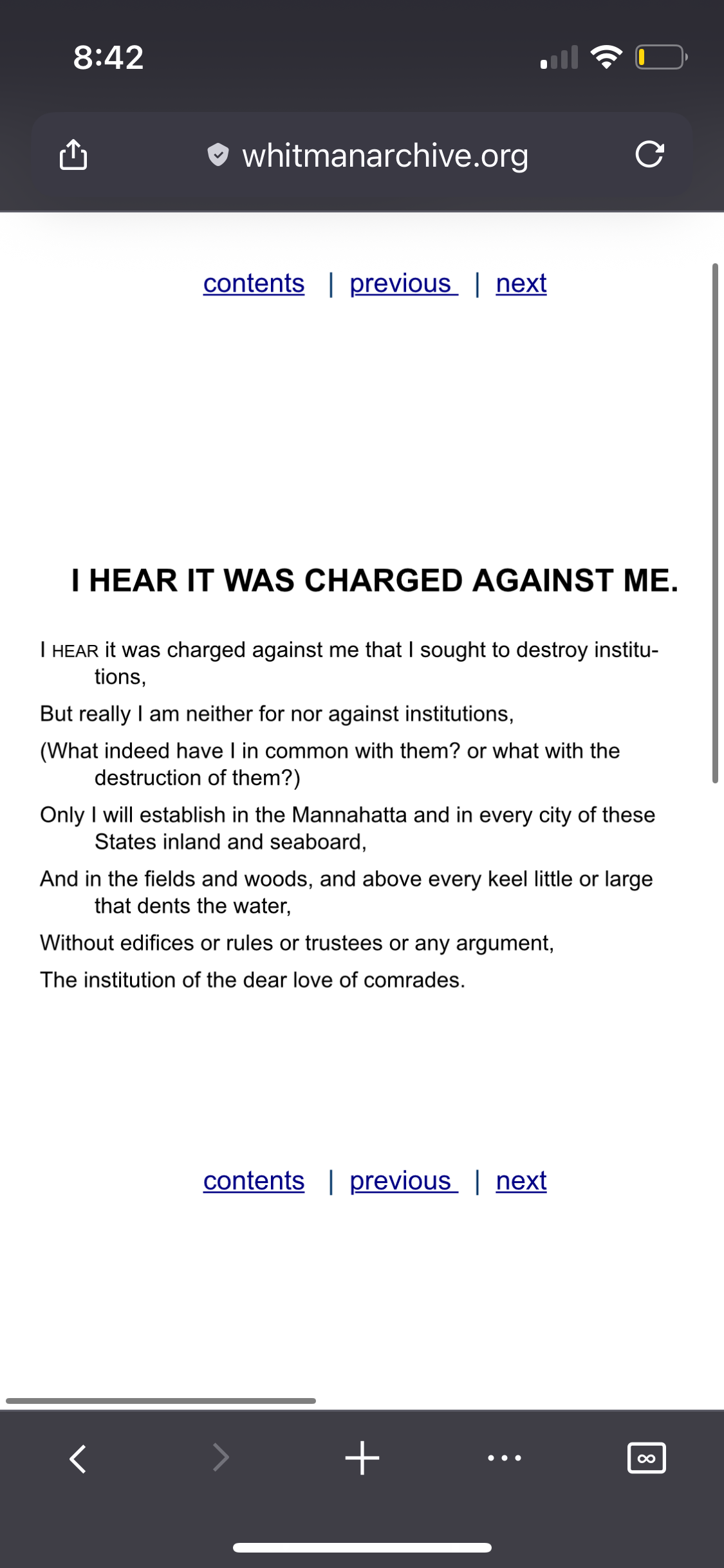
]
JK: Before we move on to the next question, was there anything that you wanted to wrap up from the previous question of political engagement?
L: I guess the only thing I would add is: when thinking about how one might engage with politics in the space of art or writing, the things that seem to be important those involved with organizing and resistance work, and then sometimes also for artists, is this idea of the imagination, of political imagination. Not even necessarily just political imagination, but there's this belief that cultivating a certain type of imagination will lead to a change.
This is something that CAConrad talks a lot about: this idea of manifesting, almost, as an extension of the imagination, [an extension] of the will of the person to triumph over a situation which seems impossible. There's this example that I don't know very well, but essentially [it’s] about this person being taken to a death camp. I think it's during the Holocaust. There's all these prisoners and prison guards, and he starts reading the palms of his fellow prisoners and telling them that they're all gonna have long lives and essentially telling them all that they're gonna survive what they're going to, which is to a gas chamber. The prison guards freak out and release them all. They just stop the car because they feel like there's some thing there, and that they are fucking with this overarching thing. CAConrad talks about this idea of cultivating this type of imagination. That poetry leads you to understand that you have more options than you might immediately think.
Without trying to draw too aggressive of a comparison, but this way of framing imagination as a tool, I feel, does come up in resistance a lot. Over here in Virginia, we just watched the Steve McQueen movie Hunger, and I tried to do a lot of reading before that about hunger strikes. You you sent me some stuff that was really helpful. In one of the articles, I think it's Amu, but somebody talks about this idea of imagination, [where a] hunger strike represents this capacity to imagine resistance, even when it seems kind of impossible; and imagine power even when it seems impossible. And that [is] part of what I think might be possible inside of creative work.
For me, I think someone who does this so beautifully is June Jordan, with just this incredibly expansive capacity to make connections across so many different political moments and politics—but showing us how they're all, at the core of these things, connected and are part of one thing. If you look at a list of June Jordan poems, you see this mind who is so attentive to all these different sorts of political struggles, and connecting them through the single poetic imaginary. So I think there's something there about imagination and about practicing a specific type of imagination. Even thinking about [the fact that] Hanif Abdurraqib talks about [how] one of the amazing things about June Jordan love poems is how their quote unquote ‘political’ aspects become intertwined with the love part. Like, “I love you and therefore I think we shouldn't have prisons.” This way in which the June Jordan love poem is this practice of showing how the capacity of love is connected always into this more collective political experience. There's something there about the imagination that I think is something that I left out when talking about what I thought might be possible [during the first half of our conversation]. I do think that that is possible to some extent. I don't know if I know how to practice that thoroughly or well yet, but that does feel like something that is there, that happens in writing or in art.
JK: Thank you so much for that. I was gonna bring up the Hanif Abdurraqib [Instagram post on] Valentine's Day. Alison got me the June Jordan book that's called Haruko / Love Poems for Valentine's Day, which actually happens to be on the table right now. That series of texts that Hanif Abdurraqib wrote, I was really struck by that one quote that he took from ‘[1977:] Poem for Mrs. Fannie Lou Hamer’ [with] that line: “‘BULLETS OR NO BULLETS! / THE FOOD IS COOKED / AN’ GETTIN COLD!’”—And this sense of, “Yeah, at the end of the day, this kind of maintenance work is completely crucial to resistance work. At the end of the day, yeah, the food is getting cold, you gotta go and eat the food, the food is there.” There are these consistent rhythms—whether we're winning or losing, or whether we feel like we're winning or feel like we're losing, we're always putting food on the table in some way… I don't know, it's just so amazing.
[I’m reminded about when I] decided that I didn't want my name on my Instagram. I was like, “Oh, I gotta change my username, and I didn't know what to change it to. I'll just change it to ‘I like June Jordan.’” And then I changed it to something, and then I changed it back. Even at the time, I was like, “I love June Jordan, but I'm scared that people are gonna think I'm an expert on her, when I'm not. So I'm just gonna say ‘like’ for now, because I don't want for people to think that I'm more than I am, or something.”
L: I love your June Jordan love also, because I don't think you've ever expressed it as [an] expertise sort of love, which I feel like we feel like we have to do sometimes. It's such a sad thing, I think, when we feel like we must be experts in order to love, you know?
JK: I think that's so impactful what you've just said—that we think that we need expertise, or that we need to prove expertise, in order to love—which I think is something that I actually succumb to all the time. I always have that imposter syndrome of, “Well, if I say that I really love something, I better be able to back it up by knowing everything about it.” And that is both in terms of passions and hobbies, but I think it's also something that I was thinking about in the context of diaspora.
The last time that I visited China [in 2023], I was hanging out with my extended family that I know very not well at all. I was struck by this feeling of alienation that I had. It was also my first time visiting ever since I realized that I was a lesbian. So I was kind of like, “Wow… I'm gay, but I'm not telling them. So I'm holding this huge secret from them.” And it makes me feel so far away from them: “I feel like they don't know me and I don't know them. I don't really know what the basis of our relationship is apart from just blood.” But then at the same time, I was also aware that they loved me. They were just always trying to feed me; they accepted my presence and did everything they could to kind of show their love in their way. I kind of came away with this observation that [on the one hand], I personally [think] that you need to know someone to love them. But [on the other hand] my relatives in China [maybe] don't think that [way], because they don't care that they don't really know anything about me. They still love me. So I was struck by that kind of contrast and how that relates to different kinds of kinship ties. But I think it's true that you don't always have to know someone to love them. But I don't know. It's quite an interesting question.
L: I think what you're saying is really interesting. I really relate with a lot of that, with Argentina stuff [in terms of] the way in which you are perceived, and then how that perception becomes a part of your own… how you're acting. I think I completely lost where I was, I had something to say and then I don't think I have anything to say anymore.
But I think what you're saying makes a lot of sense about love. Like, there's this interesting thing about love, where there's a whole thing to figure out with its relationship to information.
JK: Yeah, definitely.
L: Love's capacity to sometimes be large and instantaneous, almost, versus its capacity to actually hold that information, the information surrounding a situation.
JK: I like the way that you put that. I think about this notion that information is power, knowledge is power. If you're living under a logic of, “You have to really know something to love it,” you're basically [saying that] knowledge or information is currency. Like, you're buying your right to love, or you're buying the love by proving that you deserve it in some way. Which then, therefore, means that we're living in a system in which love is scarce, there's not enough of it to go around and, therefore, you have to justify that you can give it or that you've earned it… which, I don't know, [this mindset] is maybe a product of my westernized experience. My therapist would probably say it’s the trauma of being an immigrant and growing up in a very white space and having to really justify your presence and being terrified of losing approval. But whatever. I don't know. Ultimately, I do still kind of feel that. I can't help but feel as though I need to prove…
But then, like you say, there's abundance and instantaneity, which is probably worth moving towards.
L: Sometimes I feel like love gets treated—and is in many ways—like a fact. There's this amazing poet, Anne Spencer. She has very few poems published. She's from Lynchburg, Virginia. She was kind of involved with the Harlem Renaissance, and then she decided that she wasn't really into this. She moved back to Virginia and, I believe, married an accountant and kept a garden and wrote privately. A lot of her papers are here at UVA, in the library, and I've gotten to see some of her poems that are published—she has this amazing poem where God is talking to John Brown, and God is saying to John Brown, “I love you and I like you,” which is really big. Because love is something you don't control. (This is a paraphrasing, of course.) Love is something you don't control—I think the phrase is ‘crashing through the door’—whereas liking is something that is earned. This idea of loving and liking going side by side… Loving is something that is—I don’t know if it’s completely out of your control—but something that is more in the periphery of control and something that exists in the world outside of you. Whereas liking is something that is built, or a relationship of affection or of closeness, which develops in a different way. I think that's a really interesting idea, and in the poem, it's really interesting that liking is valued even more because it isn't this thing that happens to you, but something that grows, maybe, or that is shared in this other sort of way. I think that that sort of framework might maybe speak to a little bit of what we're talking about, but also deepens this idea of all these different sorts of connections and affections—and the labels we put onto them, the linguistic packaging.
JK: I like that. I think it makes me think about something that was on my mind recently, which is, conversely, [the important fact that] being annoying isn't a crime. In community, there's always going to be annoying people, and we need to have an ability, if someone's basically just annoying, to 1) be able to work with them, and [2)] not try to find some kind of deeper reason why they suck or something. Like, it's okay to be annoying. You can love someone and not like them, or you can work with someone and not like them. That liking is maybe a different kind of thing. I don't know if that makes sense.
L: No, it totally makes sense. I've had to deal with that. Like, I couldn't just avoid annoying people, because there were people who were undeniably, like, good people, or people that I was going to be in community with, [where] I found them annoying. It wasn't so deep that I had to go on a journey to figure out why I was annoyed by them, or I had to try to figure out why it was justified to be annoyed with them and make it deeper. It just had to be like, “You're annoyed by them, and you're gonna see them around, and you might even hang out with them, and that's okay.” You don't have to be a baby or self-justify your immediate feeling.
JK: It's okay to be annoying <3 We are annoying to others, too, so.
L: Oh, totally. I know I'm annoying to people.
JK: How did you and I meet?
L: We met in Provincetown. I remember the first night we were there together, and we all kind of sat… I remember your initial presentation to all of us and talking about being interested in the means of production or materiality or something like that. That was the context: Provincetown, Massachusetts, at a writing residency. I keep trying to remember when or if there was a moment of feeling the closeness of our relationship. Do you remember?
JK: Oh, no. I had a lot going on. It was also really weird, because you know how in the materials that they give you when you get into the residency, they have that page that's like, “Winter in Provincetown sucks so bad, and if you don't make best friends with people, you're going to get so depressed, and you're going to have the worst time ever.” So I was feeling this crazy pressure from that, and being like, “God, these are the people that I have to hang out with for the next seven months. If I don't make friends, I'm gonna die.” But then also resisting that weird anxiety—being anxious and being quite guarded at the same time, because I had a lot going on [internally]. So I also can't really pinpoint, but I should mention that you helped me so much with the pamphlet that I was doing: taught me how to bind the pamphlets and gave me your materials, and also helped me with the Riso printer and took photos for me, so that was really, really, really generous and so great. Life-changing, transformative, very cool.
L: Yeah, working on the pamphlet was a lot of fun. I do remember that page, there's a lot about that PDF that they sent us that was either very strange in terms of when you think about what that PDF is—one that's supposed to prepare people or set out policies of a place—this weird, faux encouragement that assumes an anxiety or need for sociality in the people who were receiving that PDF… As well as a lot of stuff that was just false, that they didn't care at all about, like visitors. They didn't even pretend to really care about people coming to stay, and in some cases, they were really excited about it—at least it seemed that way. It was so fluid, the people coming in and out of there. But on paper, they were really angry about that, or they seem to be [saying], “We're going to be very big sticklers about that.”
JK: What does the word care mean to you?
L: It means a lot. I think care was a really big word for me when I was in Chile. I was really interested in the field of medical cultural anthropology, because it seemed like the people who were cool there [amongst my fellow year-abroad cohort] were thinking from really interesting places and producing really interesting sorts of work in [these] academic settings [back] at my undergraduate institution. It was a small school, and there were a few very beloved professors. One of them was the medical anthropologist, and one of her classes that everybody really loved was about care in many ways. I never got to take the class, but a lot of the people who I admired most—and who showed me that there were really interesting things happening intellectually at my school—were all really invested in thinking about care, and what that could mean for ideas and for understanding relationships, how we were living.
In Chile, one of the classes I took was about care, through the anthropology department at the big Catholic university, one of the big universities in Santiago, La Católica. In that class, I was asked a lot to think about care in kinship, how care-taking was a big part of what families do, and what families produce—and also how that is a labor of sorts that especially femmes and women were doing. So I think that was an important word in a very transformative part of my life, where a lot of different things were happening, where I was participating in organizing and mutual aid and surrounded much more by a vibrant queer community in these much more political spaces. [Alongside that, I noticed care work] in my own family: my grandmother getting dementia and watching my mom be the person in the family to take charge in taking care of my grandmother; understanding the weight of how she came to be [that] person and the sorts of dynamics that went into that.
I thought a lot about this question. The definition of care, for me, it feels really important, as well as everything that is around care. To care for something, to take care of it, to help it be, nurse it—it's so related to everything that is relation; to many aspects of our social life and our life in general. I realized that at this time when I was changing a lot and growing a lot. And so, as well as what [the word ‘care’] means, just in general, I think, for me, it means this moment in my life a lot. It means trying to figure out how family works and positionalities, to relate to all the socializing and relating that we do as people.
JK: What is something that you would like to learn or learn about?
L: I'm trying to learn more songs on the guitar. I feel like that's a practice that I used to have and then I lost. I'm trying to learn how to play ‘Geordie’, the Martin Carthy version, which I believe is a Scottish folk song. From what I understood from the research I've done, [it] is related to a lot of these amazing songs that were written by Bob Dylan, that are almost these court dramas about evil judges or love affairs which end with a death that's sanctioned by the state. I think I read somewhere that it's related to this song, ‘Geordie’, and, yeah, I was obsessed with this song two weeks ago. I've been trying to learn it on the guitar.
Also something I'm trying to learn about is this idea that I've been trying to think more about, that feels very young: if the artist is a class onto its own. If you look at the material phenomena or ways of living that people who call themselves artists or writers—if that would be distinct. The question that I really care about is how the hell do you live? What does a life look like, materially, when you are trying to spend as much of your time as possible not making money, but needing some sort of money to survive? A lot of the things that you do as a writer, as an artist, it takes a lot of time and doesn't result oftentimes in any sort of financial gain. [I am] really interested in this idea of what it means, materially, to do that. Like, how would you identify this? An idea I had [is to think] about a more historical approach to studying literature, of placing the literary inside of the historical, and this more practical idea of: how it is [that] people live and live their life, and what do their lives look like, and what does it mean to be on these terms? That's something else I would like to learn about, and even though it feels not fully formed, I'm trying to talk about it with people because I hope that people will point me in directions. Or I hope someone's already done it before so I can just read it and see.
JK: That's a big question. I want to hear more about that, and I think it's definitely something I've been thinking about, ever since I dropped out of my PhD and being like, “What is my life right now? Where do I locate value? What are the definitions of value, and definitions of work?”
L: And I think that this question is also an artistic question as well, because, so often, our perceptions of the authors, or our understandings of this kind of social status / social standing / class status / class standing / identity, all these other things, become a part of how we read and become a part of how we make. So it's not solely just this question of the scientific question—even though it also is—or even just a practical question. But I think I'm interested in this question of, “What is the writer, what is the artist?” for my own sake. How do I read and understand the artist or the writer in relationship to the work? Is my understanding of them informed or interesting, one that's worth putting a stake on? I think a lot of times it can be, but I'm interested in that question, right now, in part creatively—because this question of what value is, how do I value something, feels like it also is an artistic question.
JK: Definitely. It’s that meme, almost, of how, these days, literary analysis is being like, “Wow, yeah, this work is actually metaphorically expressing or exploring its own conditions of production or something.”
L: Yeah.
JK: Is there anything else that you would like to say or to ask me?
L: No. This has been such a treat. I'm glad that we could come back and continue and finish what we've started. My only question was if there was anything lingering for you?
JK: I think we've covered so much ground—this has been a lot. I'm really happy that we got to have this chat, almost a year since our fellowship has ended. I'm really bad at keeping in touch with people, but I'm glad that this has been a way to do so.
L: Yeah, this has been really great. Thank you so much for doing this and for, for doing this sort of, like, work. It's amazing.